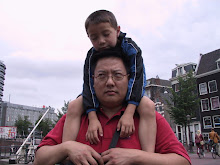
On Palm Sunday I was a bit out of sorts during the service, a bit disoriented because of everyone (not just worship leaders) processing (or is that proceeding?) into the Sanctuary/church.
Prior to that I was teaching youth group, something that I feel like I've been doing forever, not because it's something that I got to do, but because it's something that I get to do.
Within two weeks of my baptism at age 23, I was co-teaching the youth group at my church. The oldest students in that group were just six years younger than me, and all of them had a decade more experience in church life than me. It's not the sort of thing anyone plans, from the youth board's perspective or the newly baptized. It just happened, the sort of serendipity that the New Me has gotten used to, in a good way.
I don't really remember much about those early years of youth group, other than I was a ball of energy. I was excited and anxious about being 'responsible' for a group of young adults who were really not that much younger than me. The other thing I recall doing was mimicking what my favorite teachers did best: ask questions... open-ended questions. And because I was new to the church, I got to ask the teens what they thought and believed about almost anything, and in particular, why we say and do the things we do during worship service. I always got interesting answers, and often the tables were turned. I didn't always have the answers, but I always shared my thought process and then invited guest speakers to help provide answers to our persistent questions.
After about three years of that hectic pace I was feeling burnout. I discovered later that the average tenure for a youth worker is 18 months before burnout sets in. One Sunday I yelled across the church parking lot to Ed Schroeder about the Crossings classes I had heard about; soon after I enrolled in a class. It changed my life, helping me to more fully appreciate the meaning of my Baptism, to live in a way where the energy wasn't draining from me, but my energy was being replenished and renewed -- a qualitatively different kind of energy as well, coming from the Cross and the Resurrection. In short, there was a New Me.
I continued youth work for another decade until Noah came along. I could do the youth ministry while Amy was young and an only child, but with two young kids it was too much. I started again after Amy was confirmed -- the affirmation of her baptism -- and joined youth group.
I was a bit tentative the second time around because I felt that much of the 'success' in my first tour of duty was because I was unrelated to any of the youth. With some distance, the teens could be a bit more free in the discussions. But I found it didn't really matter. There's some adjustment because of the father-daughter relationship, but it's surprisingly pleasant to be able to talk about faith matters and other things in an adult way with my own daughter, especially in a group setting. It's definitely something I didn't expect and I savor every moment.
On Palm Sunday Amy wasn't at youth group because she was recovering from a weekend competition. I sort of groaned about getting up early and going because I had to do it. But the teens were marvelous, always full of energy even if much of it was grousing about waking up early on a weekend day (but hey, I felt the same way). As was the theme of the day I did everything out of pattern and sat in a different seat. I looked up and noticed a picture I rarely get to see: Poseidon from a beach, with the waves depicted as white stallions.
I mentioned how the painting reminded me of Percy Jackson and New Olympians: The Lightning Thief (because Percy is the son of -- spoiler alert -- Poseidon), and how I somewhat enjoyed the movie but after reading the book, hated the movie in solidarity with Noah's opinion. I then instinctively asked -- because it was clear we weren't going to stay on topic that day -- apart from the book to movie adaptation problem, why is it that it's easier to write books or make movies about gods other than the God we profess and confess each Sunday?
I actually wasn't prepared for the onslaught of opinions, but it was beautiful. I don't need to go into the details of the discussion, but it's safe to say we'll be revisiting this same theme later in the year. This is a wonderful phase of life these teens are going through: a time of questioning of the world, of themselves, of God, and reflecting on what these things mean to them and how to incorporate it into their daily lives.
It reminded me of when I led a Crossings weekend workshop and one of the participants, in introducing herself with name, congregation and job, described herself as a "'recovering adolescent' -- make that 'youth minister.'" I don't remember her name, but I laughed my head off at that comment and have stolen it and used it shamelessly ever since. I get to be with the youth of my church, be a recovering adolescent-in-Christ and I love every minute of it.
[This blog automatically feeds my Facebook Notes page; click here to see the original blog]
Showing posts with label EdSchroeder. Show all posts
Showing posts with label EdSchroeder. Show all posts
Tuesday, March 30, 2010

Thursday, March 25, 2010
Lent Day 32: Death Desensitized
As much as I love pop culture, my wife doesn't. Or more accurately she hates the excessive amount and intensity of violence in movies and on TV shows.
Maybe it's because I love watching and studying movies/TV and appreciate the creators' craft in portraying fantastic scenes, usually with lots of action and possibly injuries and death. I understand and know that the depictions are created; the beauty of this art form is that one can create on film a place that exists nowhere else, and may never have existed at all. I easily distinguish the portrayal from reality.
From her perspective she's worked in emergency rooms and done social work; graphic portrayals of those places in a show like ER or violence on crime shows make her queasy. She easily conflates the portrayal with reality.
I once tried to get her to watch HBO's Rome, but the graphic depiction of cavalier attitudes towards sex and violence, although only 4 minutes per 60 minute episode, marred the remaining 56 minutes of excellent drama. We do watch some shows with graphic violence, like Bones or Castle, where the main draw of the show are the relationships between the characters (mostly unresolved sexual tension), and the grisly stuff is just part of the 'case of the week.'
She also feels that the supersaturation of violence in pop culture correlates highly with violence in the real world. For years I've fought that notion, but as I grow older (and wiser?) I can't argue with it as much... especially in raising two children who are in their teens. It's one thing to watch a show with our son (12 years old) and strongly reinforce that the projected violence is just make-believe, there to entertain. It's another thing to discuss how in real life people would never do such things, and yet people actually do such things.
And then there's the death count. When I started this Lenten blog, it was about a friend's father's death and a discussion about death, dying and how to appreciate life more. With all the writing, I haven't watched as much TV or movies, so perhaps that helped reset my awareness and tolerance for depicted violence and death.
Last night I watched this week's episode of '24.' The show's premise, as groundbreaking as it was when it first burst onto the small screen years ago, is getting very long in the tooth and the series may end with this season. I was a late adapter, starting in the 5th season and watching previous seasons on DVD; I keep watching because I hope they can recapture greatness of seasons past, by adding just enough variation from previous seasons. And yet, for me the legacy of 24 was evident in Entertainment Weekly's 'body count' from a couple of years ago. Each week the magazine would update how many characters had died on the show during the emergencies that required 24 'real-time' hours of crisis management. What does it say about our culture when an entertainment magazine keeps a death toll? (I can't find a trace of 24's body count, but I did find a summer movie body count; equally disturbing.)
To grab and keep our attention, Hollywood creates bigger and deadlier menaces on screen, and death seems so trivial, and well, expected.
And even when death comes to major characters, they don't really stay dead very long, or they come back in some other form. It's not new to television or the movies -- literature and storytelling throughout the eons focus on cheating death -- and based on how much favorite actors garner big ratings or box office receipts, it totally makes sense.
But it really hit me when I took Noah to see Percy Jackson and the New Olympians: The Lightning Thief. Early in the movie, Percy and his mom are running away from a vaguely familiar (to those who studied Greek mythology) monster; how such a monster appears in the 'real world' of the movie up to that point is the first glimpse of the Olympians persisting in our world. (Or is it we who persist in their world?) Percy, who is later revealed as a demigod, vanquishes the monster -- a minotaur, but not before his mom is struck and disappears during the battle. I was actually shaken by that. I leaned over and asked Noah (who has read all the books), "did she die?" He paused, then whispered "well, I don't want to give it away."
MILD SPOILER ALERT... if you want to see the movie or read the book, stop reading this post...
His mom didn't die, or more accurately she went to Hades, and part of Percy's quest was to go there and bring her back. As in all juvenile fiction, there's a happy ending.
By the way, Noah hated the movie. He had waited anxiously for the first (and probably only) movie based on one of his favorite book series. He couldn't believe how much they changed the book to make the movie. I tried to be realistic and tell him to get used to it; movie adaptions of books will never please everybody. On his recommendation I read the first book and finished it last night. I'm just as mad as he is. The book is quite good, and the movie makes several inexplicable changes that neuter the clever updating of Olympians for our times.
But back to Noah's response: have we become so blase about death? That we automatically expect any fictional character to miraculously return to life, or somehow be able to communicate with us from the great beyond with such ease?
And how does that affect us when we're grieving over the loss of a loved one in real life? Do we compartmentalize that well? Does it ease our grieving or make an already difficult task even harder?
And at this point, I can't help thinking of one working definition of fear (from a Crossings class taken from my mentor Ed Schroeder):
[This blog automatically feeds my Facebook Notes page; click here to see the original blog]
Maybe it's because I love watching and studying movies/TV and appreciate the creators' craft in portraying fantastic scenes, usually with lots of action and possibly injuries and death. I understand and know that the depictions are created; the beauty of this art form is that one can create on film a place that exists nowhere else, and may never have existed at all. I easily distinguish the portrayal from reality.
From her perspective she's worked in emergency rooms and done social work; graphic portrayals of those places in a show like ER or violence on crime shows make her queasy. She easily conflates the portrayal with reality.
I once tried to get her to watch HBO's Rome, but the graphic depiction of cavalier attitudes towards sex and violence, although only 4 minutes per 60 minute episode, marred the remaining 56 minutes of excellent drama. We do watch some shows with graphic violence, like Bones or Castle, where the main draw of the show are the relationships between the characters (mostly unresolved sexual tension), and the grisly stuff is just part of the 'case of the week.'
She also feels that the supersaturation of violence in pop culture correlates highly with violence in the real world. For years I've fought that notion, but as I grow older (and wiser?) I can't argue with it as much... especially in raising two children who are in their teens. It's one thing to watch a show with our son (12 years old) and strongly reinforce that the projected violence is just make-believe, there to entertain. It's another thing to discuss how in real life people would never do such things, and yet people actually do such things.
And then there's the death count. When I started this Lenten blog, it was about a friend's father's death and a discussion about death, dying and how to appreciate life more. With all the writing, I haven't watched as much TV or movies, so perhaps that helped reset my awareness and tolerance for depicted violence and death.
Last night I watched this week's episode of '24.' The show's premise, as groundbreaking as it was when it first burst onto the small screen years ago, is getting very long in the tooth and the series may end with this season. I was a late adapter, starting in the 5th season and watching previous seasons on DVD; I keep watching because I hope they can recapture greatness of seasons past, by adding just enough variation from previous seasons. And yet, for me the legacy of 24 was evident in Entertainment Weekly's 'body count' from a couple of years ago. Each week the magazine would update how many characters had died on the show during the emergencies that required 24 'real-time' hours of crisis management. What does it say about our culture when an entertainment magazine keeps a death toll? (I can't find a trace of 24's body count, but I did find a summer movie body count; equally disturbing.)
To grab and keep our attention, Hollywood creates bigger and deadlier menaces on screen, and death seems so trivial, and well, expected.
And even when death comes to major characters, they don't really stay dead very long, or they come back in some other form. It's not new to television or the movies -- literature and storytelling throughout the eons focus on cheating death -- and based on how much favorite actors garner big ratings or box office receipts, it totally makes sense.
But it really hit me when I took Noah to see Percy Jackson and the New Olympians: The Lightning Thief. Early in the movie, Percy and his mom are running away from a vaguely familiar (to those who studied Greek mythology) monster; how such a monster appears in the 'real world' of the movie up to that point is the first glimpse of the Olympians persisting in our world. (Or is it we who persist in their world?) Percy, who is later revealed as a demigod, vanquishes the monster -- a minotaur, but not before his mom is struck and disappears during the battle. I was actually shaken by that. I leaned over and asked Noah (who has read all the books), "did she die?" He paused, then whispered "well, I don't want to give it away."
MILD SPOILER ALERT... if you want to see the movie or read the book, stop reading this post...
His mom didn't die, or more accurately she went to Hades, and part of Percy's quest was to go there and bring her back. As in all juvenile fiction, there's a happy ending.
By the way, Noah hated the movie. He had waited anxiously for the first (and probably only) movie based on one of his favorite book series. He couldn't believe how much they changed the book to make the movie. I tried to be realistic and tell him to get used to it; movie adaptions of books will never please everybody. On his recommendation I read the first book and finished it last night. I'm just as mad as he is. The book is quite good, and the movie makes several inexplicable changes that neuter the clever updating of Olympians for our times.
But back to Noah's response: have we become so blase about death? That we automatically expect any fictional character to miraculously return to life, or somehow be able to communicate with us from the great beyond with such ease?
And how does that affect us when we're grieving over the loss of a loved one in real life? Do we compartmentalize that well? Does it ease our grieving or make an already difficult task even harder?
And at this point, I can't help thinking of one working definition of fear (from a Crossings class taken from my mentor Ed Schroeder):
Love and hate are not opposites; love and fear are opposites. The greatest fear stems from possibly losing what, or who, you love most.
[This blog automatically feeds my Facebook Notes page; click here to see the original blog]
Wednesday, March 24, 2010
Lent Day 31: "Lost" and "Earned Grace"
Few things get me jazzed up like a hearty discussion about pop culture. Case in point: last night's episode of the TV show Lost. I have a love/hate relationship with the show because it can be fantastically intriguing and other times I wonder if the creators have any idea what they're doing.
Ever since I read that the creators have two goals -- to create an entertaining hour of television every week even for those who've never seen the show, and to have all the episodes interlock in order to reward long-time viewers -- I've been more forgiving of the zigs and zags, and will wait until the series finale to pass judgment.
But last night's episode, with a title like Ab Aeterno ("from the beginning of time") and focusing on one of the best characters, the seemingly immortal Richard who shows no sign of aging no matter how far the other characters flash forward or backward in time, had lived up to all my expectations. Long story short, Richard, in trying to save his wife by negotiating with a greedy doctor for her medicine, accidentally killed him. While imprisoned he learned English by reading a English-language Bible. Soon after the priest, speaking in their native Spanish, explained that no amount of Bible reading would save him because murderers are destined to hell, Richard's life was bought by a ship captain who needed English speakers on their trip to the New World.
The ship crashed on The Island, the focal point of Lost, and we get to see Richard struggle with physical survival and eventually mourn the loss of his wife, the dear Isabella. Because it is The Island, Richard ends up reflecting on what he'd lost in life and what he would do (which was anything) to regain his lost treasure -- Isabella. And because it's Lost, he ends up as a ping pong ball between the two main timeless characters who have warred for ages: Jacob and Ethan.
Jacob and Ethan appear as demigods, or at least as master manipulators. There are still many secrets to learn in the seven remaining episodes. What's clear is that Jacob and Ethan are foes and use the people trapped on the island (throughout the centuries) as pawns. What's not clear is who is the good one, and who's bad. Is this some sort of God and Devil conflict? No one knows. But the themes of loss, remorse, sacrifice and redemption are universal, and it's all presented in an alluring manner.
What struck me most about the episode occurred when I read some commentary this morning from Mo Ryan of the Chicago Tribune. (She, Alan Sepinwall and David Bianculli are my favorite TV critics.) Mo is an avid fan and shares everything she loves and disdains about television -- my kind of critic. Mo likens the island to a Hellmouth, as in Buffy the Vampire Slayer Hellmouth (and that's a whole 'nother geek discussion for another day), and NOT Hell. She also empathizes with Richard's loss:
But that's the way the Old Me used to think... the Old Me prior to my baptism at age 23. But truthfully, even after my baptism I continued to think that way, until a few years later I took a class from my mentor, Ed Schroeder, in one of the Crossings classes. Those classes changed my life because they showed me how the Good News permeates my daily life. Not in some sort of academic way, but rather in a very tangible "how do I get through the day and the night kind of way."
Another time I'll go deeper into that personal history, but for now, I can sum up that those Crossings classes were my Confirmation -- or affirmation of my baptism -- lessons. (As an adult baptized there was no need to take a Confirmation class.) That's when I better understood what the "New Me" means. And the biggest distinction is that no one "earns grace." At least not from the Christian perspective.
This entire season of Lent will eventually lead to the Cross and then to the Resurrection. Most people in the world know of this story irrespective of their own beliefs. Most know that it was a pivotal event in human history, that it involves the execution of Jesus and the disappearance of a body. There's been much controversy over the main elements of the story and perhaps even more controversy in the recording and differences of interpretation of those events.
For me, the New Me, the main thing that matters is believing that Jesus died for me. And rose for me. And that in that belief, all the things that kill me (like the incredible stress at work today) are swapped on the Cross and in the Resurrection.
That's not really new; a lot of other people believe this as well. What was eye-opening to the new me was/is that I don't have to do anything to receive these gifts... except to believe, that is. I don't actually deserve any of this goodness. And I can't earn any of this goodness for myself. It is gift -- grace -- pure and simple.
It sounds simple, but it's not simple in practice. I think of all the people who have been generous to me over the years -- parents, other relatives, friends -- and I've been very blessed and am grateful. Grateful to the point where I always, that is ALWAYS, want to reciprocate. Even if it's not immediate, every act of kindness that I receive I immediately think of what can I do in the future to show my appreciation.
That's not a bad thing. If humans weren't hard-wired to reciprocate kindness and generosity I can't fathom how the species could have survived let alone thrived.
But to receive something, a gift -- grace -- without earning it and without deserving it and without reciprocating, that's challenging.
That's something the New Me responds to... every day, and especially during this Lenten season. And so I keep writing...
[This blog automatically feeds my Facebook Notes page; click here to see the original blog]
Ever since I read that the creators have two goals -- to create an entertaining hour of television every week even for those who've never seen the show, and to have all the episodes interlock in order to reward long-time viewers -- I've been more forgiving of the zigs and zags, and will wait until the series finale to pass judgment.
But last night's episode, with a title like Ab Aeterno ("from the beginning of time") and focusing on one of the best characters, the seemingly immortal Richard who shows no sign of aging no matter how far the other characters flash forward or backward in time, had lived up to all my expectations. Long story short, Richard, in trying to save his wife by negotiating with a greedy doctor for her medicine, accidentally killed him. While imprisoned he learned English by reading a English-language Bible. Soon after the priest, speaking in their native Spanish, explained that no amount of Bible reading would save him because murderers are destined to hell, Richard's life was bought by a ship captain who needed English speakers on their trip to the New World.
The ship crashed on The Island, the focal point of Lost, and we get to see Richard struggle with physical survival and eventually mourn the loss of his wife, the dear Isabella. Because it is The Island, Richard ends up reflecting on what he'd lost in life and what he would do (which was anything) to regain his lost treasure -- Isabella. And because it's Lost, he ends up as a ping pong ball between the two main timeless characters who have warred for ages: Jacob and Ethan.
Jacob and Ethan appear as demigods, or at least as master manipulators. There are still many secrets to learn in the seven remaining episodes. What's clear is that Jacob and Ethan are foes and use the people trapped on the island (throughout the centuries) as pawns. What's not clear is who is the good one, and who's bad. Is this some sort of God and Devil conflict? No one knows. But the themes of loss, remorse, sacrifice and redemption are universal, and it's all presented in an alluring manner.
What struck me most about the episode occurred when I read some commentary this morning from Mo Ryan of the Chicago Tribune. (She, Alan Sepinwall and David Bianculli are my favorite TV critics.) Mo is an avid fan and shares everything she loves and disdains about television -- my kind of critic. Mo likens the island to a Hellmouth, as in Buffy the Vampire Slayer Hellmouth (and that's a whole 'nother geek discussion for another day), and NOT Hell. She also empathizes with Richard's loss:
Much of "Ab Aeterno" focused on the ideas of sin, forgiveness, grace, penance and absolution. And faith, obviously. Jacob made Richard ageless, but we found out that Richard wanted to stay alive forever so that he would not go to hell. The poor guy.When I got to the line, "If anyone has earned grace, it's him," I stopped in my tracks. In many ways it's not that noteworthy. We pretty much live our lives trying to be good, help others, make up for the bad things we do, or for the good things that we should have completed. After enough penance, we hope that we've compensated enough. We stockpile enough good stuff to make up for the bad stuff.
Whether or not the island is the actual Hell of his faith, hasn't Richard done enough penance? Hasn't he suffered enough? If anyone has earned grace, it's him. If anyone has had his faith tested, it's him -- he who thought his years on Earth were ultimately a waste of time. And what were his sins, really? He killed a man, accidentally, in order to get medicine for his wife. And then he spent several lifetimes working for a man who he thought was, ultimately, doing good things.
But that's the way the Old Me used to think... the Old Me prior to my baptism at age 23. But truthfully, even after my baptism I continued to think that way, until a few years later I took a class from my mentor, Ed Schroeder, in one of the Crossings classes. Those classes changed my life because they showed me how the Good News permeates my daily life. Not in some sort of academic way, but rather in a very tangible "how do I get through the day and the night kind of way."
Another time I'll go deeper into that personal history, but for now, I can sum up that those Crossings classes were my Confirmation -- or affirmation of my baptism -- lessons. (As an adult baptized there was no need to take a Confirmation class.) That's when I better understood what the "New Me" means. And the biggest distinction is that no one "earns grace." At least not from the Christian perspective.
This entire season of Lent will eventually lead to the Cross and then to the Resurrection. Most people in the world know of this story irrespective of their own beliefs. Most know that it was a pivotal event in human history, that it involves the execution of Jesus and the disappearance of a body. There's been much controversy over the main elements of the story and perhaps even more controversy in the recording and differences of interpretation of those events.
For me, the New Me, the main thing that matters is believing that Jesus died for me. And rose for me. And that in that belief, all the things that kill me (like the incredible stress at work today) are swapped on the Cross and in the Resurrection.
That's not really new; a lot of other people believe this as well. What was eye-opening to the new me was/is that I don't have to do anything to receive these gifts... except to believe, that is. I don't actually deserve any of this goodness. And I can't earn any of this goodness for myself. It is gift -- grace -- pure and simple.
It sounds simple, but it's not simple in practice. I think of all the people who have been generous to me over the years -- parents, other relatives, friends -- and I've been very blessed and am grateful. Grateful to the point where I always, that is ALWAYS, want to reciprocate. Even if it's not immediate, every act of kindness that I receive I immediately think of what can I do in the future to show my appreciation.
That's not a bad thing. If humans weren't hard-wired to reciprocate kindness and generosity I can't fathom how the species could have survived let alone thrived.
But to receive something, a gift -- grace -- without earning it and without deserving it and without reciprocating, that's challenging.
That's something the New Me responds to... every day, and especially during this Lenten season. And so I keep writing...
[This blog automatically feeds my Facebook Notes page; click here to see the original blog]
Wednesday, March 17, 2010
Lent Day 25: Proud Papa
Today's daily grind, which I think used to be called the "rat race," concluded in the most pleasant of ways at a Lenten Vespers service filled with beautiful contemplative music, readings, a sermon and a "proud papa" moment.
I love Vespers (or evening service) because of its reserved character, a perfect tonic at the end of the day. I'm not sure I would like the monastic life with reserved times for prayer and meditation throughout the day, but an evening service on Wednesdays throughout Advent and Lent seems about right to me. And the fact that it was right after a Lenten Vespers service that I had the guts to ask Denise for a cup of hot chocolate at the now defunct "Parkmoor" restaurant (now a Walgreen's, of course), and then over that hot chocolate ask her out for a first date makes the season even more memorable.
But today, as I left the ever-increasing pile of uncompleted tasks at the office, I rushed to church to enjoy a community supper (corned beef and cabbage, even though the church's heritage was originally strongly German), and then quickly jumped into my A/V guy mode. This is slightly odd because I was never the A/V guy in high school, but I do a lot of that now at church and at the office. My job was to get daughter Amy and best friend (of several best friends) Miriam hooked up with lavaliere (lapel) microphones for a mini-play during the service.
I had heard them practicing throughout dinner but didn't really pay attention to the lines. My job was to make sure their lines could be heard.
Amy read the Gospel lesson, and something was wrong with her mike. She was audible enough, barely from the back pew (which is not an issue because of the smaller attendance for Vespers). Turns out she couldn't reach the Un-mute switch under her shirt before she started the reading. But that was remedied in time for their play.
The play was a modern retelling of the Parable of the Prodigal Son, as told by the Elder Sister (instead of Elder Brother). Amy played the Elder Sister while Miriam played her best friend. The Elder Sister's part reflected that of the play-it-by-the-rules sibling, disdainful of the younger sibling's wasteful ways. The play did a great job in modernizing the responsible sibling's language in describing the irresponsible one... which is fantastic because most people tend to look at this parable and see how the younger sibling, after burning out from the partying life, returns home and welcomed home with a feast. Not punishing or ignoring him, but with a feast to celebrate the return of one who once was thought dead but if found alive.
One of my mentors (Ed Schroeder) taught this parable from the German translation, and the Germans call this story "The Lost Boys." It's not just the younger irresponsible one who is lost; the older one has lost his (in this case her) grasp of what's most important and not truly loving his parent and his sibling. (See here for a recent mention of Ed on lost coins, sheep and boys from Luke.) It's not just about following the rules, but about relationships, in this case the Father's love for both children, which is great enough to cover the 'good' one and the 'not-so-good' one.
As Amy read her lines she talked about her wanton younger brother and her dodo-head father. I wonder how much she enjoyed reading those lines with a 'meta' meaning, projecting onto Noah and me, even if for just a second.
On the other hand, as I was absorbing this age-old story revamped for modern audiences, and I deeply am filled with joy whenever I hear this story, I felt the 'meta' as well.
Amy and Miriam (and another friend Genevieve) have known each other for an impossibly long time; they were all in the womb (not the same one) simultaneously. They're the closest thing to blood sisters without actually sharing blood. They love each other, but also treat each other... well as one would treat siblings. And here they were, portraying best friends in a church skit.
Miriam and Amy, in particular, have always loved putting on shows. From the time they could speak they would stand on a stairwell landing, jointly singing songs they loved. They won't admit to liking this, but they used to sing the best of Barney's (the purple dinosaur) songs. Eventually they would mimic their favorite sketches, then other songs, then ad-libbing their lines. They both love "Wicked," and for Miriam's birthday one year we gave her the piano/song book from that musical.
To see them tonight, delivering a pitch-perfect dramatic rendition of this updated parable, makes my heart sing. It's not just the quality of their performance or their talent. It's because they contributed to our worship in their own unique way, reflecting their special relationship. They're not blood sisters, in the literal sense. But the bond they share, in their faith and the sacraments, may be even stronger than blood ties. So, it wasn't just their speaking the lines well, it's that the lines were being spoken from their hearts, of a story they know well of God's love and what it means to their lives.
So tonight I am a proud papa... and also humbled by the blessings of Amy and Miriam in my life.
[This blog automatically feeds my Facebook Notes page; click here to see the original blog]
I love Vespers (or evening service) because of its reserved character, a perfect tonic at the end of the day. I'm not sure I would like the monastic life with reserved times for prayer and meditation throughout the day, but an evening service on Wednesdays throughout Advent and Lent seems about right to me. And the fact that it was right after a Lenten Vespers service that I had the guts to ask Denise for a cup of hot chocolate at the now defunct "Parkmoor" restaurant (now a Walgreen's, of course), and then over that hot chocolate ask her out for a first date makes the season even more memorable.
But today, as I left the ever-increasing pile of uncompleted tasks at the office, I rushed to church to enjoy a community supper (corned beef and cabbage, even though the church's heritage was originally strongly German), and then quickly jumped into my A/V guy mode. This is slightly odd because I was never the A/V guy in high school, but I do a lot of that now at church and at the office. My job was to get daughter Amy and best friend (of several best friends) Miriam hooked up with lavaliere (lapel) microphones for a mini-play during the service.
I had heard them practicing throughout dinner but didn't really pay attention to the lines. My job was to make sure their lines could be heard.
Amy read the Gospel lesson, and something was wrong with her mike. She was audible enough, barely from the back pew (which is not an issue because of the smaller attendance for Vespers). Turns out she couldn't reach the Un-mute switch under her shirt before she started the reading. But that was remedied in time for their play.
The play was a modern retelling of the Parable of the Prodigal Son, as told by the Elder Sister (instead of Elder Brother). Amy played the Elder Sister while Miriam played her best friend. The Elder Sister's part reflected that of the play-it-by-the-rules sibling, disdainful of the younger sibling's wasteful ways. The play did a great job in modernizing the responsible sibling's language in describing the irresponsible one... which is fantastic because most people tend to look at this parable and see how the younger sibling, after burning out from the partying life, returns home and welcomed home with a feast. Not punishing or ignoring him, but with a feast to celebrate the return of one who once was thought dead but if found alive.
One of my mentors (Ed Schroeder) taught this parable from the German translation, and the Germans call this story "The Lost Boys." It's not just the younger irresponsible one who is lost; the older one has lost his (in this case her) grasp of what's most important and not truly loving his parent and his sibling. (See here for a recent mention of Ed on lost coins, sheep and boys from Luke.) It's not just about following the rules, but about relationships, in this case the Father's love for both children, which is great enough to cover the 'good' one and the 'not-so-good' one.
As Amy read her lines she talked about her wanton younger brother and her dodo-head father. I wonder how much she enjoyed reading those lines with a 'meta' meaning, projecting onto Noah and me, even if for just a second.
On the other hand, as I was absorbing this age-old story revamped for modern audiences, and I deeply am filled with joy whenever I hear this story, I felt the 'meta' as well.
Amy and Miriam (and another friend Genevieve) have known each other for an impossibly long time; they were all in the womb (not the same one) simultaneously. They're the closest thing to blood sisters without actually sharing blood. They love each other, but also treat each other... well as one would treat siblings. And here they were, portraying best friends in a church skit.
Miriam and Amy, in particular, have always loved putting on shows. From the time they could speak they would stand on a stairwell landing, jointly singing songs they loved. They won't admit to liking this, but they used to sing the best of Barney's (the purple dinosaur) songs. Eventually they would mimic their favorite sketches, then other songs, then ad-libbing their lines. They both love "Wicked," and for Miriam's birthday one year we gave her the piano/song book from that musical.
To see them tonight, delivering a pitch-perfect dramatic rendition of this updated parable, makes my heart sing. It's not just the quality of their performance or their talent. It's because they contributed to our worship in their own unique way, reflecting their special relationship. They're not blood sisters, in the literal sense. But the bond they share, in their faith and the sacraments, may be even stronger than blood ties. So, it wasn't just their speaking the lines well, it's that the lines were being spoken from their hearts, of a story they know well of God's love and what it means to their lives.
So tonight I am a proud papa... and also humbled by the blessings of Amy and Miriam in my life.
[This blog automatically feeds my Facebook Notes page; click here to see the original blog]
Subscribe to:
Posts (Atom)